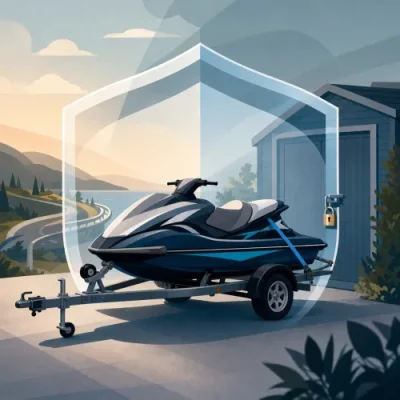
Many jet ski owners spend almost as much time moving and storing their personal watercraft as they do riding it. Your jet ski may be kept at home, parked at a marina, transported on a trailer, left at a holiday property or stored for months during the off-season. That raises an important insurance question: is your jet ski covered while it is being towed, trailered or stored?
The short answer is that it depends on the type of jet ski insurance you hold, the wording of your policy, how the jet ski and trailer are secured, where they are kept and what caused the loss or damage. This article explains the common issues to check so you can ask better questions when comparing cover or speaking with an insurer or broker.
Is a jet ski covered while being towed?
Some comprehensive personal watercraft insurance policies may cover accidental loss or damage to the jet ski while it is being transported on a trailer, but this is not automatic across every policy. Transit cover can be limited by policy conditions, exclusions and the way the jet ski is secured.
When reviewing jet ski insurance towing cover, check whether the policy refers to:
- damage to the jet ski while being transported by road;
- theft of the jet ski from a trailer;
- damage caused by collision, rollover, fire, storm or attempted theft while in transit;
- requirements for tie-downs, covers, locks or other securing devices;
- limits on unattended parking while the jet ski is on the trailer;
- whether the trailer itself is included, optional or excluded.
Do not assume your car insurance will cover damage to the jet ski simply because the trailer is attached to your vehicle. Motor vehicle insurance and jet ski insurance usually cover different risks. A car policy may deal with vehicle-related liability or damage to the insured car, while your PWC policy may be the relevant policy for damage to the jet ski itself. The exact position depends on the policies involved.
Trailering, road transit and launch-ramp risks
Trailering a jet ski creates risks that are different from riding it on the water. Common transit and launch-ramp scenarios include the jet ski shifting on the trailer, impact damage while reversing, trailer failure, theft during a fuel stop, or damage while launching or retrieving the PWC.
A policy may treat these scenarios differently. For example, damage during road transport may be covered under one section, while damage during launching or retrieval may fall under another. Some policies may require the trailer to be roadworthy, registered where required, and suitable for the jet ski. If the trailer was unsafe, overloaded or poorly maintained, a claim may be affected.
Before you tow, consider these practical checks:
- Secure the jet ski properly: use appropriate straps, winch points and safety chains, and check them during longer trips.
- Check the trailer: tyres, wheel bearings, lights, brakes if fitted, winch, rollers and bunks should be in sound condition.
- Use theft deterrents: hitch locks, wheel clamps and secure parking can help reduce theft risk and may be relevant to policy conditions.
- Avoid leaving it unattended where possible: some policies apply stricter conditions when a jet ski or trailer is left unattended in a public place.
- Keep maintenance records: records for the trailer and jet ski can help if an insurer asks how the equipment was maintained.
If your concern is towing a disabled jet ski on the water rather than transporting it by road, see this related guide to securely towing a disabled jet ski back to shore. On-water towing can involve different safety and liability considerations from road trailering.
Does PWC trailer insurance cover the trailer itself?
PWC trailer insurance is an area where assumptions can be costly. Some jet ski policies may automatically include a trailer up to a policy limit. Others may require the trailer to be listed separately, added as an optional benefit or insured under a separate trailer or boat policy. Some may cover the jet ski but not the trailer, or may only cover the trailer in limited circumstances.
When comparing policies, ask whether the trailer is covered for:
- accidental damage while attached to the towing vehicle;
- damage while parked or stored;
- theft or attempted theft;
- storm, fire, flood or malicious damage;
- damage during launch or retrieval;
- liability arising from trailer use, if applicable.
Also check the insured value. If the trailer is included only up to a modest limit, that may not be enough to replace a specialised or newer trailer. The policy schedule and Product Disclosure Statement should confirm whether the trailer is listed, its insured value and any excess that applies.
Jet ski storage insurance: at home, marina or storage facility
Jet ski storage insurance depends heavily on where the PWC is kept and how secure that location is. Insurers commonly ask about storage because theft, vandalism, storm damage and corrosion risks vary between a locked garage, an open driveway, a marina hardstand, a storage yard or a mooring arrangement.
Common storage locations include:
| Storage location | Insurance issues to check |
|---|---|
| Home garage or locked shed | Whether the address is listed correctly and whether locks, alarms or other security measures are required. |
| Driveway or carport | Whether the jet ski must be chained, locked, covered or kept out of public view when unattended. |
| Marina or boat yard | Whether the insurer accepts the location and whether there are conditions around access, supervision or storm preparation. |
| Commercial storage facility | Whether the facility is acceptable to the insurer and whether proof of storage arrangements may be needed. |
| Holiday property or temporary address | Whether temporary storage away from the listed address is covered and for how long. |
If you change where your jet ski is stored, notify your insurer or broker. A policy may be priced or accepted based partly on the usual storage address and security arrangements. Failure to disclose a material change could affect cover, depending on the circumstances and policy terms.
Theft, locks and unattended storage conditions
Theft is one of the major reasons storage conditions matter. A jet ski on a trailer can be moved quickly if it is not secured, especially when parked in a driveway, storage yard or public area.
Your policy may include conditions about reasonable care, anti-theft devices or securing the PWC and trailer. Examples may include using a hitch lock, wheel clamp, chain, locked garage, locked yard or approved storage facility. The exact requirements vary between insurers, so check your own policy wording rather than relying on general assumptions.
Good storage habits may also help reduce the chance of a claim. For practical security ideas, you may find this guide to protecting your jetski against theft useful alongside your policy review.
What about lay-up, winter storage or seasonal use?
Some owners use their jet ski mostly in warmer months and store it for part of the year. A policy may refer to lay-up periods, seasonal cover or restrictions on use during certain times. In some cases, limited-use or lay-up arrangements may affect the premium or cover, but this depends on the insurer and the policy selected.
Before relying on seasonal storage arrangements, check:
- whether the jet ski is still covered for theft, fire, storm or accidental damage while laid up;
- whether riding during a declared lay-up period affects cover;
- whether the jet ski must be stored at a particular address;
- whether fuel, battery or maintenance requirements apply;
- whether accessories and the trailer remain covered during storage.
Insurance is only one part of off-season protection. Mechanical preparation also matters. If you are storing your PWC for winter or an extended break, this guide to winterizing your jet ski explains maintenance steps that may help protect the craft while it is not in use.
Comprehensive versus third party cover for towing and storage
The type of policy you choose has a major impact on towing, transit and storage protection. Comprehensive jet ski insurance generally offers broader cover for accidental damage, theft and certain insured events, subject to the policy terms. Third party cover is typically more focused on liability to other people or property and may not cover damage to your own jet ski.
That means a third party policy may be inadequate if your main concern is theft from a trailer, storm damage in storage or accidental damage to your own PWC during transport. However, comprehensive cover also has limits, exclusions and excesses, so it is important to review the Product Disclosure Statement and policy schedule carefully.
When comparing options, ask:
- Is my jet ski covered while being towed on a trailer?
- Is the trailer included, optional or excluded?
- What happens if the jet ski is stolen while attached to the trailer?
- Are there limits for accessories, safety gear or modifications?
- Does cover apply at my normal storage address and temporary storage locations?
- What security conditions apply when the jet ski is unattended?
- Are there exclusions for racing, commercial use, unlicensed operation or use outside approved areas?
Common exclusions that may affect transit or storage claims
Every policy is different, but exclusions and claim conditions can be especially important when a jet ski is not being ridden. Issues that may affect a towing, transport or storage claim include:
- Wear and tear: policies generally do not cover gradual deterioration, corrosion or mechanical failure unless an insured event causes resulting damage that is covered.
- Poor maintenance: neglected trailer bearings, unsafe tyres, faulty straps or known defects may create problems if they contribute to the loss.
- Unsecured property: leaving the jet ski, trailer or accessories unsecured may affect theft cover.
- Incorrect storage information: if the insurer was told the jet ski is kept in a locked garage but it is usually parked elsewhere, this may be relevant to a claim.
- Flood, storm or cyclone conditions: some policies include specific weather-related exclusions, limitations or preparation requirements.
- Commercial or hire use: personal PWC cover may not apply if the jet ski is used for business, hire, tuition or organised events unless agreed.
These are general examples only. The actual result depends on the policy wording, the facts of the incident and the insurer's assessment.
Information to provide when getting quotes
Accurate information helps insurers assess the risk and offer terms that reflect your circumstances. When seeking jet ski insurance quotes, be ready to provide details about the jet ski, trailer and storage arrangements.
Useful information may include:
- make, model, year and approximate value of the jet ski;
- whether the trailer should be insured and its value;
- where the jet ski is usually stored;
- how it is secured at home and when travelling;
- how often and how far you tow it;
- whether it is stored seasonally or laid up for part of the year;
- any modifications, accessories or safety equipment;
- who rides it and where it is used.
If you have a specific storage or towing arrangement, such as marina storage, a shared holiday property, interstate travel or a high-value trailer, it may be worth discussing the details before buying cover. You can also use the site's brokers page if you want help identifying policy questions to raise with a specialist.
Questions to ask before towing or storing your jet ski
Before your next trip or off-season storage period, it can help to work through a short insurance checklist:
- Does my policy cover accidental damage to the jet ski while it is being transported?
- Is theft from a trailer covered if the jet ski is parked away from home?
- Is my trailer listed on the policy, and for what value?
- Are accessories, covers, safety gear or electronics included?
- What security devices must I use at home, at a marina or while travelling?
- Is temporary storage at another address covered?
- Do I need to tell my insurer before long-term storage or a change of address?
- Are there exclusions for storm, flood, corrosion, poor maintenance or unroadworthy trailers?
- What evidence would I need if I made a claim?
Key takeaway
A jet ski may be covered while being towed, trailered or stored, but only if your policy includes the relevant cover and you meet its conditions. The main points to check are transit cover, trailer cover, theft protection, storage location, security requirements and any lay-up or seasonal-use terms.
Because policy wording varies, do not rely on assumptions. Read the Product Disclosure Statement, review the policy schedule and ask direct questions about your towing and storage arrangements before you need to make a claim.