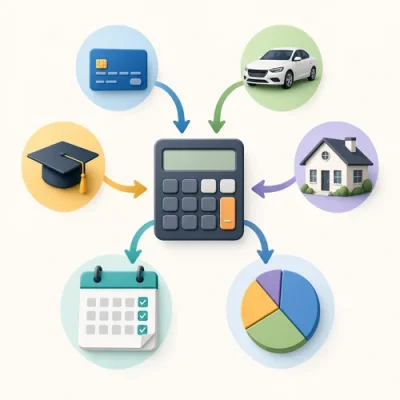
If you are juggling several repayments, a debt consolidation calculator can help you estimate what may happen if those debts are combined into one loan. It can be especially useful when comparing current credit card balances, personal loans or other unsecured debts against a possible consolidation loan.
The key word is estimate. A calculator cannot tell you whether a lender will approve your application or what rate you will be offered. It can, however, help you understand the relationship between your debt amount, interest rate, fees, loan term, monthly repayment and total interest paid.
Before you compare debt consolidation loans, use the steps below to make your calculator result more practical and less misleading.
What a debt consolidation calculator is designed to show
A debt consolidation calculator usually compares two broad scenarios:
- Your current debt position: the balances, repayments, interest rates and fees across your existing debts.
- A possible consolidated loan: one new loan amount, interest rate, term, fees and estimated repayment.
Depending on the calculator, the output may show an estimated repayment, total interest over the loan term, total amount repaid, or a possible cost difference compared with keeping your debts as they are.
You can start with the site's debt consolidation calculator to test different loan amounts, repayment terms and interest rate assumptions. Treat the result as a planning guide rather than a quote or recommendation.
Information to gather before you use the calculator
The more accurate your inputs are, the more useful your estimate is likely to be. Before using a debt consolidation repayment calculator, gather your most recent statements or online account details for each debt you may want to include.
Useful information includes:
- Current balance: how much you owe on each credit card, personal loan, store card or other debt.
- Interest rate: the annual rate for each debt, noting that credit cards may have different rates for purchases, cash advances and balance transfers.
- Minimum repayment: what you are currently required to pay each month.
- Actual repayment: what you usually pay, which may be higher than the minimum.
- Fees: account fees, annual card fees, early repayment costs or establishment fees that may apply.
- Remaining term: for existing loans, how long is left until the debt is due to be repaid.
For credit cards, it can also help to note whether you are still using the card. A calculator may assume the balance is fixed, but ongoing spending can change the real outcome substantially.
How to enter your current debts
Start by entering each existing debt separately if the calculator allows it. This helps you see the combined monthly repayment and total cost of your current arrangements.
If the tool only allows one current debt figure, add the balances together carefully. You may also need to estimate an average interest rate. This is less precise, especially if you have one large low-rate loan and one smaller high-rate credit card balance.
When entering current debts, avoid these common shortcuts:
- Using the credit limit instead of the balance: the balance is what you owe now, while the limit is how much you are allowed to borrow.
- Ignoring fees: fees can affect the comparison even when the interest rate looks lower.
- Entering only the minimum repayment: if you usually pay more than the minimum, include your real repayment behaviour where the calculator asks for it.
- Leaving out small debts: several smaller balances can still affect your total repayment and borrowing assessment.
How to enter the proposed consolidation loan
Next, enter the details of the possible consolidation loan. If you do not yet have an offer, use realistic assumptions and test more than one scenario.
The main inputs are usually:
- Loan amount: the total amount you want to consolidate, plus any costs you plan to include in the loan.
- Interest rate: the rate you want to test. Actual rates depend on the lender, your credit profile, income, expenses, existing debts and other criteria.
- Loan term: how long you would take to repay the loan.
- Repayment frequency: monthly, fortnightly or weekly, depending on the calculator.
- Upfront or ongoing fees: establishment, account-keeping or other fees if known.
If you are comparing lenders, be careful not to focus only on the advertised rate. The comparison needs to consider fees, term length and the total amount repaid over time.
Understanding the calculator results
A debt consolidation repayment estimate may look simple, but the result needs careful interpretation. Lower monthly repayments can be helpful for cash flow, but they do not automatically mean the loan costs less overall.
| Calculator result | What it may tell you | What to check before deciding |
|---|---|---|
| Estimated monthly repayment | How much the proposed loan may cost each month | Whether the repayment fits your budget after essential living expenses |
| Total interest | How much interest may be paid over the loan term | Whether a longer term increases the total cost even if monthly repayments fall |
| Total amount repaid | The loan principal plus estimated interest and fees | Whether the total is lower or higher than your current repayment path |
| Potential cost difference | An estimated comparison between current debts and the new loan | Whether the assumptions match your real debts, spending and repayment habits |
Why a lower repayment may still cost more
One of the biggest risks when using a debt consolidation calculator is focusing only on the monthly repayment. A longer loan term can reduce the amount due each month, but it may also mean interest is charged for longer.
For example, if you spread a debt over a longer period, your budget may feel less stretched in the short term. However, the total interest over the life of the loan could be higher than a shorter repayment plan. This is why it is important to compare both the repayment and the total cost.
A useful approach is to run at least three scenarios:
- A shorter term: higher repayments, but potentially less interest over time.
- A middle term: a balance between monthly affordability and total cost.
- A longer term: lower repayments, but potentially higher total interest.
None of these scenarios is automatically right or wrong. The suitable option depends on your income, expenses, debt level, repayment discipline and lender criteria.
How fees can change the estimate
Fees can make a loan more expensive than it first appears. If the calculator has fields for upfront and ongoing fees, use them. If it does not, make a separate note so you do not forget them when comparing options.
Possible costs to consider include:
- loan establishment fees;
- monthly or annual account fees;
- early repayment or exit costs on existing loans;
- late payment fees if repayments are missed;
- balance transfer fees if you are comparing a balance transfer card; and
- broker or third-party fees, if applicable.
Not every fee will apply to every borrower or product. Check the lender's documents carefully and ask questions if anything is unclear.
Using the calculator to compare credit card debt consolidation
A debt consolidation calculator can be helpful when you are considering whether to consolidate credit card debt into a personal loan. Credit card interest can be difficult to estimate because repayments are often flexible and ongoing card use can increase the balance.
When entering credit card debt, consider whether you are comparing:
- paying only the minimum repayment;
- paying a fixed amount above the minimum;
- transferring the balance to another card; or
- consolidating the balance into a personal loan with structured repayments.
If you plan to keep using the credit card after consolidating, the calculator may understate the real cost. A consolidation loan may simplify existing debts, but it does not stop new debt from building up unless your spending habits and budget also change.
What a calculator cannot tell you
A calculator can help you calculate debt consolidation savings or cost differences, but it cannot account for every factor that affects a real lending decision.
It generally cannot confirm:
- whether you meet a lender's eligibility criteria;
- what interest rate you will actually be offered;
- whether a secured or unsecured loan is more appropriate for you;
- how your credit file may be affected by a new application;
- whether you can comfortably maintain repayments if your income or expenses change; or
- whether consolidation is the most suitable debt relief option for your circumstances.
Australian lenders generally assess factors such as income, expenses, credit history, existing liabilities and capacity to repay. If your circumstances are complex, you may want help interpreting your options before applying.
Questions to ask after using a debt consolidation calculator
Once you have your estimate, use it as a starting point for better questions rather than as a final answer.
- Is the repayment affordable? Check it against your regular income, rent or mortgage, bills, groceries, transport and other essentials.
- Is the total cost lower? Compare total interest and total repayments, not just the monthly figure.
- What assumptions did I use? If you entered an optimistic interest rate or ignored fees, rerun the calculation more conservatively.
- Will I close or stop using old credit accounts? Keeping old credit available may increase the risk of building up debt again.
- What happens if my budget changes? Consider whether you could still repay the loan if expenses rose or income reduced.
- Are there alternatives? Debt negotiation, hardship arrangements, budgeting changes or financial counselling may be worth considering depending on your situation.
It is also worth reviewing common mistakes to avoid when consolidating debts, particularly if the calculator result looks attractive but your budget is still tight.
How to make your estimate more realistic
To get a more useful debt consolidation loan cost estimate, test your numbers carefully. Small changes in rate, term or fees can make a noticeable difference over time.
Practical ways to improve your estimate include:
- using current balances from recent statements rather than rough memory;
- including all debts you realistically want to consolidate;
- testing more than one interest rate assumption;
- comparing shorter and longer loan terms;
- including fees where known;
- checking both repayment amount and total cost; and
- building the proposed repayment into a written budget before applying.
If the repayment only works when every assumption is favourable, the option may be riskier than it first appears. A calculator is most helpful when it encourages you to stress-test the decision, not just confirm what you hoped to see.
When to get extra help
You may benefit from extra support if you are behind on repayments, relying on credit for essentials, unsure which debts to prioritise, or finding that every calculator scenario still leaves your budget under pressure.
A broker may be able to explain borrowing options across different lenders, but any loan outcome will depend on your circumstances and the lender's assessment. If you are experiencing financial hardship, a free financial counsellor or your existing creditors may also be appropriate starting points.
The bottom line
A debt consolidation calculator is a practical tool for estimating repayments, total interest and possible cost differences. It can help you see whether a new loan may simplify your repayments or change your overall costs.
The most important step is to look beyond the headline repayment. Check the loan term, total interest, fees and your ability to avoid new debt. Used carefully, the calculator can help you ask better questions before deciding whether to compare loan options or seek further guidance.