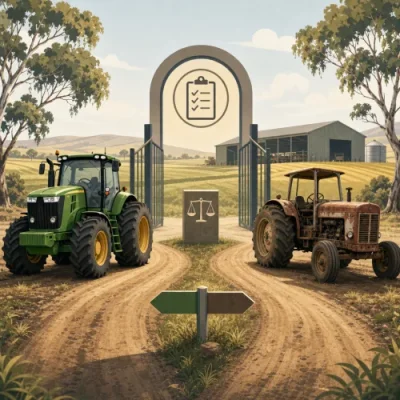
Financing new and used farm machinery can help eligible Australian farming businesses spread the cost of essential equipment over time. However, the finance assessment is not only about the borrower. The machinery itself can influence the structure, term, deposit, valuation and approval conditions.
This guide explains what farmers should understand before financing new, used or replacement machinery, including how asset age, condition, useful life and agricultural equipment resale value may affect the finance discussion.
Why the asset matters in farm machinery finance
With farm equipment finance, the machinery is often a key part of the lender’s assessment. Depending on the finance structure, the equipment may be used as security for the loan or lease. That means lenders commonly consider whether the asset is identifiable, marketable, suitable for the farm’s operation and likely to retain enough value over the finance term.
Two farmers may apply for the same purchase price, but receive different finance options because the equipment differs. A near-new tractor from a recognised dealer with service records may be assessed differently from an older private-sale machine with uncertain hours, limited records or specialised use.
Common asset-related factors include:
- Age and working hours: Older equipment or high-hour machinery may have a shorter remaining useful life.
- Condition and maintenance history: Service records, inspection reports and repair history can help support the asset’s value.
- Make, model and market demand: Machinery with stronger resale demand may be viewed differently from highly specialised or hard-to-sell equipment.
- Purchase source: Dealer purchases, auctions and private sales may require different checks and documentation.
- Intended use: Equipment should generally align with the farm’s production needs and income-generating activity.
New farm machinery finance: common considerations
New machinery may appeal to farmers who need reliability, modern technology, manufacturer support or capacity for future growth. It may also be easier to document because the purchase price, specifications and supplier details are usually clear.
When financing new machinery, lenders may consider factors such as the invoice price, warranty details, delivery timing, proposed finance term and how the equipment fits the farm’s cash flow. New machinery can still depreciate, so it is important to think beyond the initial purchase and consider the total cost of ownership.
Potential advantages of financing new machinery
- Clear purchase documentation: A supplier quote or invoice can make the asset and price easier to verify.
- Modern features: Newer equipment may support efficiency, precision agriculture, fuel management or safety improvements.
- Warranty and support: Warranty coverage may reduce some early repair uncertainty, although exclusions and limits can apply.
- Longer potential working life: A new asset may support a longer finance term than older equipment, subject to lender criteria.
Points to watch with new machinery
New machinery usually involves a higher purchase price than comparable used equipment. Even if repayments are manageable, farmers should consider whether the additional cost is justified by productivity gains, reliability, warranty support or operating savings.
It is also worth asking how the equipment’s value may change over time. Some machinery holds value better than others, depending on brand reputation, demand, condition, hours and technological relevance. A higher purchase price does not automatically mean stronger resale value.
Used farm machinery finance: common considerations
Used machinery can be a practical option for farmers who want to reduce upfront cost, replace an asset quickly or purchase equipment that is well suited to an existing operation. Used tractor finance in Australia, for example, may be considered for farm businesses that need dependable pulling power without purchasing a new machine.
Used equipment can also come with additional assessment questions. Lenders may want greater comfort around age, condition, ownership history, market value and whether the asset will remain useful for the full finance term.
Potential advantages of financing used machinery
- Lower purchase price: Used equipment may reduce the amount financed compared with new machinery.
- Slower depreciation in some cases: Some assets may have already experienced a large portion of their early depreciation, although future value still depends on condition and market demand.
- Immediate availability: Used equipment may be available sooner than some new models, which can matter during planting, harvesting or time-sensitive operating windows.
- Fit-for-purpose replacement: A well-maintained used machine may be adequate where a new model is not necessary for the farm’s workload.
Risks and checks for used machinery
Used machinery finance should include careful asset due diligence. Before committing, farmers may want to review service history, hours, wear points, ownership details, attachments, compatibility with existing implements and whether parts and servicing are available locally.
For private sales or auction purchases, additional checks may be needed to confirm the seller has the right to sell the asset and that there are no unresolved security interests. A lender, broker or solicitor may help explain what checks are relevant to the transaction.
New versus used machinery finance at a glance
| Factor | New machinery | Used machinery |
|---|---|---|
| Purchase price | Usually higher, depending on model, options and supplier | Often lower, but condition and market demand vary |
| Documentation | Supplier quote, invoice and specifications are usually straightforward | May require valuation, service records, ownership checks or inspection details |
| Finance term | May support a longer term if the asset has a longer expected working life | May be shorter where age, hours or condition limit remaining useful life |
| Deposit requirement | May depend on borrower profile, asset type, purchase price and lender criteria | May be more likely where the lender wants to reduce risk on older or less certain assets |
| Resale value | Can depend on brand, technology, demand and depreciation | Can be affected strongly by condition, hours, maintenance and buyer demand |
| Repair risk | May be partly managed by warranty, subject to terms | May require more allowance for maintenance, repairs and downtime |
How valuation affects machinery finance
Farm equipment valuation is important because the lender may compare the requested finance amount with the asset’s fair market value. If the purchase price appears high for the age, condition or market, the lender may request more information, a valuation or a larger contribution from the borrower.
Valuation can be more straightforward for common machinery with an active second-hand market. It may be more difficult for specialised equipment, modified machinery, imported units, older machines or assets with limited local demand.
Farmers can prepare by collecting:
- supplier invoices or written quotes;
- make, model, year, serial number and hours;
- photos or inspection notes where relevant;
- service records and repair history;
- details of attachments, modifications or included implements;
- comparable sale information, if available.
Deposits, loan-to-value and borrower contribution
A machinery loan deposit may be required depending on the lender, borrower profile, equipment type and transaction details. In some cases, a lender may finance a high proportion of the purchase price. In other cases, the lender may ask the farmer to contribute a deposit or reduce the financed amount.
Deposits are not only about affordability. They can also reflect asset risk. For example, an older used machine, an equipment purchase above market value or a specialised asset with limited resale demand may lead a lender to seek a larger borrower contribution.
When comparing options, farmers should consider the effect of a deposit on working capital. Using too much cash upfront may reduce flexibility for fuel, labour, seed, fertiliser, repairs, livestock feed or other seasonal expenses. On the other hand, borrowing more may increase total interest cost and repayment pressure.
Choosing a finance structure
Farm machinery may be financed through different structures, including chattel mortgage, hire purchase, finance lease or other asset finance arrangements. The suitable structure depends on the farm’s circumstances, accounting treatment, tax position, cash flow and lender availability.
This article is general information only and does not provide tax, legal or financial advice. Farmers should consider speaking with an accountant or suitably qualified adviser about GST, depreciation, deductibility and ownership implications before choosing a structure.
Useful questions to ask include:
- Who owns the machinery during and after the finance term?
- Is there a balloon, residual or final payment?
- Can repayments align with seasonal income?
- What happens if the equipment is sold, upgraded or replaced early?
- Are there early repayment fees, break costs or restrictions?
- What insurance is required over the financed asset?
Matching repayments to farm cash flow
Farm income can be seasonal and exposed to weather, commodity prices, input costs and market conditions. A repayment that looks manageable on an average month may become difficult during low-income periods.
Some lenders may consider repayment structures that better reflect agricultural cash flow, such as monthly, quarterly or seasonal repayment patterns. Availability depends on the lender, asset, borrower profile and transaction details.
Before applying, farmers can use a repayment estimate to compare purchase prices, deposit amounts, terms and balloon options. The site’s finance calculator may help you test repayment scenarios before discussing options with a broker or lender.
Replacement machinery and trade-ins
Many farmers finance machinery as part of a planned replacement cycle rather than a one-off purchase. Replacing older machinery can reduce downtime, improve productivity or address changing operational needs. However, the finance decision should account for the existing asset as well as the new one.
If trading in machinery, consider whether the trade-in value is realistic and whether any existing finance must be paid out. If selling privately, allow time for inspections, payment settlement and transfer of ownership. If refinancing or consolidating equipment finance, check fees and whether extending debt over a longer period increases total cost.
A replacement decision should be based on more than the repayment amount. Consider repair costs, expected hours, downtime risk, operator safety, parts availability, fuel use and whether the machinery supports the farm’s production plan.
What lenders may ask for
Documentation requirements vary, but a farm machinery finance application may involve information about both the business and the asset. Lenders may request financial statements, tax returns, bank statements, ABN details, trust or company information, asset and liability details, supplier invoices and information about the equipment being purchased.
For used equipment, additional information may be requested to support value and condition. For newer farmers or complex structures, lenders may also ask for extra background on income, contracts, land access, production history or existing debts.
Because criteria can vary between lenders and finance providers, farmers who want help comparing options may choose to speak with a finance broker. You can learn more about that pathway through the site’s brokers page.
Questions to ask before financing new or used machinery
- Is the machinery essential to current operations, future growth or both?
- Is the purchase price supported by market value and condition?
- How long is the equipment likely to remain productive on this farm?
- Will the finance term exceed the practical working life of the asset?
- What deposit is required, and how will that affect working capital?
- Are repayments aligned with seasonal cash flow?
- What maintenance, repair, insurance and storage costs should be budgeted?
- How easy would the equipment be to sell or trade in later?
- What happens if drought, flood, price changes or production issues reduce income?
In Conclusion
New and used farm machinery finance can both be potentially useful, but they are assessed differently because the asset matters. New machinery may offer clearer documentation, warranty support and longer potential working life. Used machinery may reduce purchase cost, but valuation, condition, service history and resale demand become especially important.
Before applying, compare the equipment’s value, useful life, deposit requirement, finance term and repayment structure. The right approach depends on the farm’s circumstances, the machinery being purchased and the criteria of the lender or finance provider.