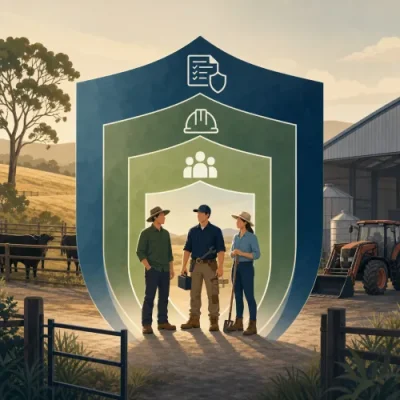
Farm insurance is often discussed in terms of buildings, machinery, crops and livestock. But people-related risks can be just as important for Australian farm businesses. If your farm uses employees, contractors, seasonal workers, labour hire, family members or volunteers, you may need to consider workers compensation, public liability, contractor insurance requirements and workplace safety obligations.
This article provides general educational information for farm owners, agribusiness managers and rural employers. It does not replace legal, insurance, accounting or workplace relations advice. Rules and policy outcomes can vary depending on your state or territory, business structure, activities, insurer and individual circumstances.
Why worker and contractor risks matter in farm insurance
Farms can be complex workplaces. A single property may involve machinery operation, animal handling, chemical use, vehicle movement, fencing, shearing, harvest labour, transport contractors, fencing contractors, mechanics, agronomists, volunteers and visitors.
When someone is injured, property is damaged, or a third party alleges negligence, the relevant cover may not be the same as the cover you use for storm damage or machinery theft. A farm package policy may include several sections, but not every people-related exposure is automatically covered.
For broader context on common rural cover types, the Farm Insurance page explains how farm insurance can be considered across assets, liability and business risks. This article focuses specifically on workers compensation and contractor-related exposures.
Farm workers compensation in Australia: the key principle
Workers compensation in Australia is generally regulated at state and territory level. If your farm employs workers, you may be required to hold workers compensation insurance or be covered under the relevant scheme for your jurisdiction. The details can vary, including who is treated as a worker, how premiums are calculated, what records are needed and how claims are managed.
Farm operators should avoid assuming that a general farm liability policy replaces workers compensation. Public liability and farm liability cover are usually designed for claims by third parties, not statutory workers compensation obligations for employees.
People who may create workers compensation obligations
Depending on the circumstances and the rules in your jurisdiction, workers compensation issues may arise for:
- full-time, part-time and casual farm employees;
- seasonal harvest workers;
- farmhands, station hands, machinery operators and livestock workers;
- some contractors who may be deemed workers under workers compensation rules;
- apprentices, trainees or work experience participants;
- family members who are paid or who work in the business in a structured way;
- workers supplied through labour hire arrangements, depending on the arrangement and jurisdiction.
The label used in a contract is not always decisive. A person called a contractor may still be treated as a worker for certain legal or insurance purposes if the actual arrangement has employee-like features. This is one reason farms should seek appropriate advice before relying on assumptions.
Employees, contractors and volunteers are not the same insurance risk
Different categories of people can trigger different insurance issues. The following table outlines common considerations, but it is not a substitute for checking the rules and policy wording that apply to your farm.
| Person on the farm | Common insurance issues to consider | Questions to ask |
|---|---|---|
| Employee or casual worker | Workers compensation, workplace safety, payroll records, employment records, incident reporting | Are they covered under the correct workers compensation scheme? Are duties and safety procedures documented? |
| Seasonal worker | Workers compensation, accommodation risks, transport arrangements, training, supervision | Who employs them? Are they covered from day one? Are induction and language needs addressed? |
| Independent contractor | Public liability, contractor's own insurance, workers compensation status, injury to contractor, damage caused by contractor | Have you sighted current certificates of currency? Does the contract allocate responsibility clearly? |
| Labour hire worker | Host employer duties, labour hire provider insurance, workplace safety, state-based labour hire rules | Who is the employer? What insurance does the provider hold? What duties remain with the farm? |
| Volunteer | Volunteer personal accident cover, public liability, workplace safety, activity restrictions | Are volunteers covered for injury? Are they doing hazardous tasks that should be restricted? |
| Family member helping on farm | Workers compensation status, personal accident, liability, informal work arrangements | Are they an employee, contractor, unpaid helper or business participant? Has this been documented? |
How public liability interacts with worker-related incidents
Public liability or farm liability insurance may help respond to certain claims where the farm is alleged to have caused injury or property damage to another person. However, policy wording matters, and many liability policies contain exclusions or limitations for injuries to employees or people who should be covered under workers compensation.
For example, if a visitor is injured at a farm gate, public liability may be relevant. If a paid employee is injured operating machinery, workers compensation is more likely to be the primary issue. If a contractor is injured, the outcome may depend on the facts, the contract, the contractor's own insurance, state or territory law and the farm's policy wording.
For a broader discussion of third-party legal exposures, see Agribusiness Risk: Liability Issues Facing Australian Farmers Today.
Contractor insurance: what farms should check before work starts
Contractors are common in agriculture. A farm may engage contractors for fencing, spraying, earthmoving, harvesting, shearing, transport, repairs, agronomy, electrical work, building work or livestock services. Even where a contractor runs their own business, the farm may still face risk if something goes wrong on the property.
Before a contractor starts work, consider asking for evidence of relevant insurance. This may include:
- Public liability insurance: relevant if the contractor causes injury or property damage to someone else.
- Workers compensation insurance: relevant where the contractor employs workers or is required to hold cover under applicable rules.
- Personal accident or income protection insurance: sometimes relevant for sole traders, noting this does not replace your own obligations and depends on the contractor's arrangements.
- Motor vehicle or plant insurance: relevant where vehicles, trucks, harvesters, earthmoving equipment or other plant are brought onto the property.
- Professional indemnity insurance: relevant for professional advice or design services, such as some agronomy, engineering or consultancy work.
Ask for certificates of currency, but remember that a certificate is only a snapshot. It does not prove that every activity is covered, that all conditions are met, or that the policy will respond to a particular incident. For higher-risk work, it may be worth asking the contractor to confirm that the specific activity is within the scope of their cover.
Seasonal workers and labour hire arrangements
Seasonal labour is essential for many farms, especially during planting, harvest, shearing, packing and peak livestock periods. Insurance questions can become more complicated when workers are sourced through labour hire providers, contractors or short-term arrangements.
Important questions include:
- Who is the legal employer of the worker?
- Which party is responsible for workers compensation insurance?
- Does the labour hire provider hold appropriate insurance and, where applicable, licensing?
- What workplace health and safety duties remain with the farm as the host workplace?
- Who provides induction, supervision, equipment and training?
- Are transport and accommodation arrangements part of the work arrangement?
Even when another business supplies the worker, the farm may still have workplace safety duties because the work is being performed on the farm. Insurance should be reviewed alongside operational controls, contracts and induction procedures.
Farm volunteer insurance and informal help
Volunteers can be involved in community working bees, emergency clean-ups, animal care, rural events, farm stays, educational visits or family support. Volunteer arrangements can create difficult insurance questions because volunteers may not be employees, but they can still be injured or cause damage while helping.
Some organisations arrange volunteer personal accident cover. Some farm policies may include limited cover for volunteers, while others may not. The availability and scope of cover depends on policy wording and the circumstances of the activity.
Farms should be cautious about allowing volunteers or informal helpers to perform high-risk tasks such as operating heavy machinery, using chemicals, working at heights, handling dangerous livestock or driving unregistered vehicles. Even if someone is unpaid, workplace safety duties and negligence risks may still arise.
Family labour and blurred arrangements
Many Australian farms rely on family members. A spouse, adult child, sibling or parent may help during busy periods, manage livestock, operate machinery, perform bookwork or take part in decision-making. These arrangements can be practical, but they can also blur the line between employee, business owner, unpaid family helper and contractor.
Insurance questions to clarify include whether the family member is paid, whether wages are recorded, whether they are a director, partner, trustee or beneficiary, whether they operate their own business, and whether they are covered under any personal accident, income protection or workers compensation arrangement.
Clear records can make a significant difference if there is an injury or claim. Informal arrangements are common in agriculture, but insurers and regulators may still look at the actual facts of the working relationship.
State and territory differences are important
Australian workers compensation, workplace safety and labour hire rules are not identical across the country. A farm operating in New South Wales may face different scheme requirements from a farm in Queensland, Victoria, Western Australia, South Australia, Tasmania, the Northern Territory or the ACT. Cross-border farms and contractors who work in multiple jurisdictions may need extra care.
Differences can affect:
- who is considered a worker;
- when a workers compensation policy is required;
- how wages or remuneration are declared;
- whether certain contractors are deemed workers;
- labour hire licensing or host employer obligations;
- claims reporting processes;
- return-to-work obligations;
- penalties for non-compliance.
Because these issues are jurisdiction-specific, farm operators should check with the relevant state or territory authority, insurer, broker or professional adviser. Where state-based policy questions arise, the Brokers page may be a useful starting point for finding insurance support.
Common gaps and assumptions to avoid
People-related farm insurance problems often arise because of assumptions made before work begins. Common examples include:
- Assuming a contractor is always responsible for their own injuries: the legal and insurance position may be more complex, especially if the contractor is under the farm's direction or performing employee-like work.
- Assuming public liability covers employees: employee injuries are usually a workers compensation issue, subject to applicable laws and policy terms.
- Assuming family members are automatically covered: cover depends on the relationship, payment arrangement, business structure and policy wording.
- Assuming volunteers have the same protection as employees: volunteers may require separate consideration, such as volunteer personal accident cover.
- Failing to update the insurer when operations change: adding accommodation, events, agritourism, contracting services or new labour arrangements can change the risk profile.
- Relying only on verbal agreements: written contracts, induction records and certificates of currency can be important if a claim or dispute occurs.
Questions to ask your insurer or broker
When reviewing rural workplace insurance, it can help to ask practical, specific questions rather than only asking whether you have "farm insurance". Useful questions include:
- Does our current farm policy include public liability cover, and what exclusions apply for workers, contractors and volunteers?
- Do we need workers compensation cover for any employees, casuals, family members or deemed workers?
- How should seasonal workers and labour hire workers be treated under our insurance arrangements?
- Are volunteers covered for injury, or would separate volunteer personal accident cover be needed?
- What insurance evidence should we collect from contractors before they start work?
- Are high-risk activities such as spraying, shearing, fencing, machinery operation, welding or earthmoving treated differently?
- Do we need to notify the insurer if contractors regularly use our equipment or vehicles?
- How are claims handled if both the farm and contractor may share responsibility?
- Are there any policy conditions about workplace safety, licensing, maintenance or record-keeping?
Record-keeping can support claims and compliance
Good records do not guarantee a claim will be accepted, but they can help clarify what happened and which policy may respond. Farms should consider maintaining:
- employment and contractor agreements;
- certificates of currency from contractors;
- induction and training records;
- safe work procedures for hazardous tasks;
- incident and near-miss reports;
- equipment maintenance records;
- chemical handling and machinery licences where relevant;
- visitor and volunteer sign-in records for organised activities;
- emails or written instructions confirming the scope of work.
These records can also support broader on-farm risk management. For more on identifying and reviewing farm risks, see Secure Your Farm's Future: Understanding the Importance of On-Farm Risk Assessment.
What to do after a worker, contractor or volunteer incident
If someone is injured or property is damaged, immediate safety comes first. Arrange medical assistance where needed, make the area safe and follow any emergency procedures. After that, the farm should consider notification obligations and insurance requirements.
Depending on the incident, you may need to:
- record the details of what happened, including time, location, people involved and witnesses;
- preserve relevant evidence, such as photos, equipment records or job instructions;
- notify your workers compensation insurer or scheme agent if an employee or covered worker is involved;
- notify your farm insurer or broker if there may be a liability claim;
- notify the contractor's insurer if contractor insurance is relevant;
- comply with any workplace safety regulator notification requirements for serious incidents;
- avoid admitting liability before receiving advice from your insurer or adviser;
- cooperate with claims, investigation and return-to-work processes.
Insurance policies often contain notification requirements. Delays can complicate claims, especially where multiple insurers or parties are involved.
Building worker and contractor risks into your annual insurance review
Farm operations change over time. A property that once used only family labour may later engage contractors, run farm tours, employ backpackers, host volunteers or operate a side business. These changes can affect both insurance and compliance obligations.
At least annually, and before major seasonal work begins, consider reviewing:
- how many workers you engage and in what capacity;
- whether any contractors could be deemed workers;
- which contractors perform high-risk tasks;
- whether volunteers or informal helpers are involved;
- whether labour hire providers are used;
- whether your farm activities have expanded beyond what your insurer knows about;
- whether policy limits, exclusions and excesses remain appropriate;
- whether certificates of currency and contracts are up to date.
The aim is not simply to buy more cover. It is to understand which risks exist, which obligations apply, which policies may respond and where practical controls can reduce the chance of an incident.
Key takeaways
Australian farms that use workers, contractors, seasonal labour, volunteers or family help should treat people-related insurance as a core business risk. Workers compensation is usually separate from general farm liability insurance and is governed by state and territory rules. Contractor insurance can reduce uncertainty, but it does not automatically remove the farm's own responsibilities.
Before work starts, clarify the worker's status, check relevant insurance, document responsibilities and review the tasks being performed. If in doubt, seek advice from a qualified insurance broker, legal adviser, accountant or relevant regulator. The right approach will depend on your farm's structure, location, activities and the people involved.