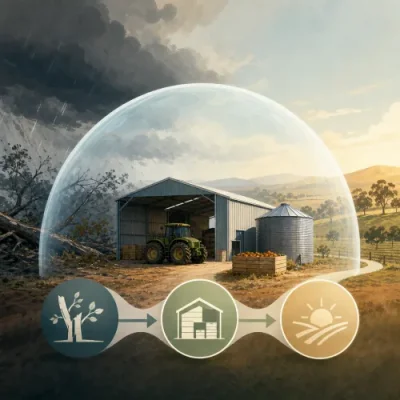
Farm business interruption insurance is designed to respond when an insured event disrupts the normal operation of a farm business. While farm property insurance may help repair or replace damaged buildings, machinery or other insured assets, business interruption cover focuses on the financial impact of being unable to operate as usual.
For Australian farmers and agribusiness operators, this can be an important part of continuity planning. A fire in a packing shed, storm damage to key infrastructure, theft of essential machinery or insured damage to a dairy, cool room or workshop can affect more than the asset itself. It may also delay production, reduce sales, increase operating costs and put pressure on cash flow.
This article explains how farm business interruption insurance and farm loss of income cover may work, what typically triggers a claim, what limits and conditions to review, and how it differs from personal income protection or crop revenue protection.
What is farm business interruption insurance?
Farm business interruption insurance is a type of cover that may compensate a business for certain financial losses after an insured event interrupts trading or production. In a farm context, it is often considered alongside broader farm insurance arrangements that cover property, machinery, liability, livestock, crops or other rural assets.
The key point is that business interruption cover usually depends on a trigger. In many policies, the trigger is physical loss or damage to insured property caused by an insured peril. For example, if a covered fire damages a processing building and the farm cannot fulfil orders while repairs are underway, business interruption cover may help address the resulting loss of income, subject to the policy terms.
The exact wording matters. Some policies may use terms such as business interruption, loss of income, loss of gross profit, increased cost of working or additional increase in cost of working. These terms are not always interchangeable, and each policy can define them differently.
How farm loss of income cover may respond after an insured event
When an insured event disrupts farm operations, farm loss of income cover may help by addressing the financial gap between the farm's expected trading position and its actual position during the interruption period. The insurer will generally assess the cause of the disruption, the policy trigger, the financial records and the amount of loss that can be linked to the insured event.
Depending on the policy, cover may respond to costs or losses such as:
- Loss of gross profit or revenue: where the farm's income is reduced because insured damage prevents normal operations.
- Increased costs of working: extra expenses reasonably incurred to reduce the interruption, such as temporary hire of equipment, alternative storage, contract processing or short-term relocation of part of the operation.
- Continuing fixed costs: certain expenses that continue even though production or sales are reduced, depending on the policy definition.
- Wages or key staff costs: some policies may address wages as part of the interruption calculation or through specific extensions.
- Claims preparation costs: some policies may include limited cover for professional costs involved in preparing a complex claim, if specifically included.
Not all policies cover all of these items. The farm's insured activities, the selected cover, the declared figures, the policy limit and the insurer's assessment all affect the outcome.
Examples of insured farm disruptions
Business interruption cover is not intended to respond to every downturn in farm income. It is generally linked to insured damage or another insured event. Common scenarios that may be relevant include:
- Fire damage to a shearing shed, dairy, packing shed or workshop that prevents normal operations while repairs are completed.
- Storm or hail damage to insured farm buildings that interrupts storage, processing or dispatch.
- Theft or insured damage to key machinery where operations slow or stop until replacement equipment is available.
- Insured damage to refrigeration or storage facilities that affects the farm's ability to hold or prepare produce for sale.
- Damage to access or on-farm infrastructure where the relevant policy extension applies.
Each example depends on the policy wording. If the underlying event is not insured, business interruption cover may not respond.
What business interruption cover usually does not do
One of the most important parts of understanding agricultural business interruption cover is knowing what it is not designed to cover. In general, business interruption insurance does not provide a broad guarantee of farm income.
Depending on the policy, exclusions or limitations may apply to:
- income reductions caused by uninsured drought, seasonal variation or poor yields;
- ordinary market price movements or reduced commodity prices;
- losses not caused by an insured event;
- gradual deterioration, wear and tear or maintenance-related issues;
- delays caused by underinsurance, incomplete records or disputes about the cause of damage;
- losses outside the selected indemnity period;
- events or locations not listed or described in the policy; and
- biosecurity, disease, contamination or utility interruption events unless specifically covered.
This is why policy wording, schedules and endorsements should be reviewed carefully. A cover that appears suitable in summary form may have conditions that significantly affect how it works in practice.
Business interruption versus personal income protection
Farm business interruption insurance is often confused with income protection insurance for farmers. They address different risks.
Personal income protection generally relates to an individual's ability to earn income if illness or injury prevents them from working. It is usually focused on the insured person, not on damage to farm property or disruption to business operations. You can read more about that separate concept in our guide to income protection for farmers.
Farm business interruption cover, by contrast, is usually tied to the farm business. It may respond where an insured event damages property or otherwise triggers the policy and causes a measurable business loss. It is not generally designed to replace a farmer's personal income because they are sick or injured.
| Cover type | Main focus | Typical trigger | Key question |
|---|---|---|---|
| Farm business interruption insurance | Business income and operating continuity | Insured event disrupting farm operations | Has the farm business lost income or incurred extra costs due to an insured interruption? |
| Personal income protection | The insured person's income | Illness or injury preventing work, subject to policy terms | Can the insured person work and earn income? |
| Crop insurance | Insured crop loss or production risk | Covered crop event, depending on policy | Has an insured crop loss occurred? |
Business interruption versus crop or livestock insurance
Crop insurance and livestock insurance can be highly relevant to farm income, but they usually work differently from business interruption cover.
Crop insurance may address damage to, or loss of, insured crops depending on the policy type and insured events. Livestock insurance may respond to certain animal losses, theft, transit risks or disease-related events where covered. Business interruption cover is more concerned with the operational and financial disruption that follows a covered event.
For example, if a covered storm damages an insured packing shed and produce cannot be sorted or dispatched on time, business interruption cover may be relevant to the disruption to sales or increased costs of arranging alternatives. If the crop itself is damaged, crop insurance may also need to be considered, depending on the farm's cover. These covers can interact, but one does not automatically replace the other.
Key policy settings to review
Farm business interruption insurance can be technical. Before relying on it, farmers should understand the main settings that determine how a claim may be assessed.
The insured event or trigger
Check what must happen before cover can respond. Many business interruption sections require physical damage to insured property caused by an insured peril. Some policies may include extensions for specific events such as prevention of access, public utilities or supplier or customer interruption, but these extensions are not automatic and may have strict limits.
The sum insured or declared values
The sum insured should reflect the financial exposure the farm wants to insure. Underestimating turnover, gross profit or continuing expenses can create underinsurance risk. Overestimating figures may increase premiums without necessarily improving the claim outcome. The calculation method should match the policy wording and the farm's accounting structure.
The indemnity period
The indemnity period is the maximum period the policy may cover the interruption, subject to the policy terms. On farms, the recovery period can depend on seasonal timing, rebuilding delays, machinery availability, contractor access, livestock cycles and planting or harvest windows. A short indemnity period may not be enough for some operations.
The waiting period or excess
Some business interruption covers apply a time-based waiting period, a monetary excess or both. A waiting period means the farm may need to absorb losses for a specified initial period before cover responds. This can be especially important where disruption is short but costly.
The basis of settlement
Policies may calculate loss using gross profit, gross revenue, output, increased costs or other defined measures. The words used in the policy schedule and wording are important. A farm accountant or insurance broker may help translate business records into the figures needed for insurance purposes.
Information commonly needed for a claim
A business interruption claim often requires more than evidence of physical damage. The insurer may need to understand how the insured event affected the farm's trading position.
Useful records may include:
- sales records, invoices and contracts before and after the event;
- profit and loss statements, tax records and management accounts;
- production records, yield records or dispatch logs;
- repair quotes, replacement timelines and supplier correspondence;
- records of temporary costs incurred to keep operating;
- photos, incident reports and maintenance records; and
- notes showing decisions made to reduce the interruption.
Prompt notification and organised documentation can make the claim process easier. For broader guidance on handling farm insurance claims, see The Farmer's Handbook to Quick and Effective Insurance Claims.
Questions to ask before choosing farm business interruption cover
Because every farm operates differently, the right questions are often more useful than a generic checklist. When comparing policies or reviewing existing cover, consider asking:
- Which insured events can trigger the business interruption section?
- Does the cover apply only after damage to insured property?
- Are machinery breakdown, utility interruption, prevention of access or supplier interruptions included or excluded?
- How is loss of income calculated under the wording?
- What records will be required to support a claim?
- What indemnity period is available, and is it long enough for seasonal recovery?
- Does the policy account for peak periods such as harvest, shearing, calving or processing windows?
- How are increased costs of working assessed?
- Are there sub-limits for particular extensions?
- Could underinsurance affect the payout?
If the policy wording is unclear, it may be worth discussing definitions, limits and waiting periods with an insurance broker or adviser familiar with rural businesses. You can also review available support through the site's brokers page.
How to think about the amount of cover
Choosing a level of business interruption cover usually requires more than estimating last year's income. Farm revenue can be seasonal, volatile and dependent on production cycles. A useful review may consider:
- expected turnover or gross profit for the insurance period;
- fixed costs that would continue during a disruption;
- seasonal peaks and timing of key revenue events;
- how long repairs or replacement could realistically take;
- availability of contractors, alternative premises or substitute machinery;
- the cost of temporary measures to keep trading; and
- the financial impact of missing a planting, harvest, shearing or delivery window.
The purpose is not to predict every possible event perfectly. It is to make sure the insured amount, indemnity period and policy structure are reasonably aligned with the way the farm earns income and recovers from disruption.
Practical steps for farm continuity planning
Insurance is one part of managing operational disruption. Farms can also reduce the impact of interruption by planning ahead.
- Map critical assets: identify the buildings, equipment, systems and infrastructure that would stop or slow operations if damaged.
- Keep financial records current: business interruption claims are easier to support when records are accurate and accessible.
- Review seasonal exposure: consider how the same insured event would affect the farm differently at harvest, lambing, calving or planting time.
- Identify backup options: consider alternative suppliers, machinery hire, storage, transport or processing arrangements.
- Update insured values: review changes in turnover, production mix, machinery, buildings and operating costs.
- Document risk controls: maintenance, fire protection, security and emergency procedures may support risk management and claims handling.
Key takeaway
Farm business interruption insurance can help address loss of income and extra costs when an insured event disrupts farm operations. It is not a general income guarantee and it does not usually replace personal income protection, crop insurance or livestock insurance. Its value depends on the policy trigger, insured events, limits, waiting periods, indemnity period, declared values and the farm's ability to document the loss.
For Australian farm businesses, the most important step is to review business interruption cover as part of the overall farm insurance program, rather than treating it as an afterthought. The right questions can help identify whether the cover reflects the farm's real recovery risks and cash flow exposure.