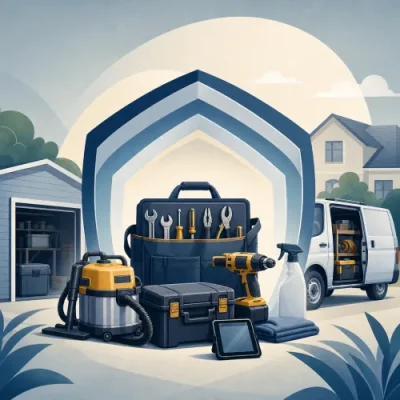
Tools, equipment and portable business property are central to many home services businesses. Cleaners may rely on vacuums and specialised cleaning machines, gardeners may carry mowers and trimmers, and maintenance providers may transport power tools, ladders, test equipment or mobile devices between client sites.
If those items are stolen, damaged or lost, the disruption can be immediate. Tools and equipment insurance for home services businesses is designed to help with this asset risk, but cover varies significantly between insurers, policy types and business activities. This article explains the general principles so you can ask better questions when comparing options or speaking with a broker.
What is tools and equipment insurance?
Tools and equipment insurance is a broad term often used to describe cover for business-owned portable items used to perform work. Depending on the insurer, it may also be referred to as portable property insurance, general property cover, tools of trade cover, business equipment insurance or a section within a broader business insurance package.
For home services businesses, this cover may be relevant because many operators do not work from a single shopfront or office. Instead, equipment is commonly:
- stored at home, in a garage, shed or small workspace;
- kept in a work vehicle or trailer;
- carried between client homes;
- used outdoors, on driveways, gardens or building areas;
- left temporarily at a job site or client premises; or
- moved between storage, suppliers and service locations.
Insurance terms differ, so it is important to read the policy wording and schedule carefully. Some policies cover specified items only, while others may provide a general limit for a category of portable business property.
Why portable property matters for home service providers
Many domestic service operators run lean businesses. A sole trader or small team may not have spare equipment ready if key tools are stolen or damaged. Even relatively modest equipment losses can affect bookings, income, customer relationships and the ability to complete jobs.
Examples of portable business property that may be relevant include:
- hand tools and power tools;
- gardening and landscaping equipment;
- cleaning machines and commercial vacuum cleaners;
- pressure washers and carpet cleaning equipment;
- ladders, safety gear and trade accessories;
- stock, materials or consumables carried for jobs;
- testing or measuring equipment;
- portable point-of-sale devices, tablets, laptops or phones used for work; and
- small machinery, attachments, trailers or specialist equipment, where accepted by the insurer.
Not every item will be covered automatically. Higher-value equipment, electronic devices, trailers or machinery may need to be listed separately or insured under a different section of the policy.
What risks may tools and equipment insurance cover?
Cover depends on the policy, but common insured events may include theft, accidental damage, fire, storm, collision or damage while items are being transported. Some policies may cover equipment at your premises, in a vehicle, at a client's premises or temporarily away from your main business location.
The table below summarises common areas to check. It is not a substitute for a policy wording, as each insurer sets its own conditions, exclusions and limits.
| Area to check | Why it matters |
|---|---|
| Where items are covered | Some policies may limit cover to Australia, certain premises, vehicles or nominated locations. |
| Theft from vehicles | Insurers may require locked vehicles, secured toolboxes, alarms, visible forced entry or restrictions for overnight storage. |
| Specified versus unspecified items | High-value items may need to be individually listed, while lower-value items may sit under a general limit. |
| Single item limits | A policy may have an overall sum insured but still cap payment for any one item. |
| Accidental damage | Some policies include accidental damage, while others may only cover named events such as fire or theft. |
| Replacement basis | Claims may be settled on replacement cost, market value, depreciated value or another basis stated in the policy. |
| Excesses | The excess affects how much you contribute if a claim is accepted. |
What may not be covered?
Exclusions are just as important as inclusions. A policy may not respond if the loss falls outside the agreed cover, if security conditions were not met, or if the item was not adequately described or valued.
Common limitations or exclusions may include:
- wear and tear, gradual deterioration, rust or corrosion;
- mechanical or electrical breakdown, unless specifically insured;
- theft from an unlocked vehicle, unsecured area or unattended location;
- unexplained disappearance or stocktake shortages;
- damage caused by improper use, poor maintenance or overloading;
- tools owned personally by employees or subcontractors, unless the policy includes them;
- items used for activities not disclosed to the insurer;
- software, data loss or cyber-related losses on laptops or phones;
- property outside the geographic area covered by the policy; and
- items above policy limits unless individually specified.
Because exclusions differ, home service providers should avoid assuming that all portable property is covered simply because they have business insurance. If equipment is essential to your work, confirm how it is treated under the actual policy.
Tools and equipment insurance is different from liability cover
Tools and equipment insurance protects your own business property, subject to the policy terms. Public liability insurance, by contrast, generally relates to claims that your business caused injury to another person or damage to someone else's property. Professional indemnity insurance is different again and may relate to claims involving professional advice, errors or omissions.
For example, if a mower is stolen from a locked trailer, that may be a tools or portable property issue. If the mower throws debris and damages a client's glass door, that may raise a public liability question. If you provide incorrect professional advice that causes a client financial loss, professional indemnity may be more relevant.
Many home services businesses need to consider these covers together rather than separately. You can start broader business insurance enquiries through Domestic Services Insurance Online, then compare how different policy sections address your liability and asset risks.
How to work out what equipment value to insure
Choosing a sum insured is not always straightforward. Underinsuring may leave you short if several items are stolen or damaged at once, while overinsuring may mean paying for a level of cover you do not need. The right amount depends on your business assets, provider criteria and the settlement basis in the policy.
A practical starting point is to create an asset register. This can include:
- item name and description;
- brand, model and serial number;
- purchase date;
- purchase price or estimated replacement cost;
- receipts, tax invoices or photos;
- where the item is usually stored;
- whether it is taken to client sites; and
- whether it is owned, financed, leased or hired.
An asset register can help you decide what to insure and may also support a claim. It is also useful for broader risk planning. For more practical risk reduction ideas, see our article on identifying common risks in the home service industry and how to mitigate them.
Vehicle storage and overnight theft conditions
For mobile service providers, theft from vehicles is one of the most important areas to review. Many home service businesses keep tools in utes, vans, trailers or roof boxes because unpacking them every night is inconvenient. However, insurers may impose specific security conditions.
Depending on the policy, you may need to consider whether:
- the vehicle must be locked and fully secured;
- tools must be stored out of sight;
- equipment must be kept in a locked toolbox or permanently fixed compartment;
- there are different rules for overnight storage;
- there must be visible signs of forced entry;
- trailers must use locks, clamps or other security devices;
- cover applies at private homes, public streets, worksites and client premises; and
- any theft excess or sub-limit applies.
If your normal work pattern involves leaving equipment in a vehicle overnight, disclose this when arranging cover. It is better to understand the insurer's position before a claim occurs.
Do home-based businesses need separate equipment cover?
Running a business from home does not automatically mean your home and contents insurance will cover business tools or equipment. Domestic home policies often limit or exclude business property, particularly if it is used to earn income, stored in a vehicle or taken away from the home.
Home-based service providers should check whether their personal insurance covers business assets at all, and if so, under what limits and conditions. In many cases, a business insurance policy or portable property section may be more appropriate, depending on the nature and value of the equipment.
This is especially relevant if clients, platforms, landlords, financiers or commercial partners require evidence of particular cover. Requirements can vary, and having a policy does not necessarily mean it will satisfy every contract or job condition.
Questions to ask before choosing cover
When comparing equipment insurance for a small business, consider asking the insurer or broker:
- Which of my tools, machines, devices and materials are covered?
- Do high-value items need to be specified individually?
- Is theft from a vehicle covered, including overnight?
- What security conditions apply to vehicles, trailers, sheds and storage areas?
- Are items covered while being used at a client's property?
- Are hired, leased or financed items covered?
- Are employee or subcontractor tools covered?
- Does cover include accidental damage, or only named insured events?
- How are claims settled: replacement, repair, market value or depreciated value?
- What excesses, waiting periods, sub-limits or exclusions apply?
- What evidence will be needed if a claim is made?
If you are unsure how different policy options apply to your specific business, you can use the Brokers page to discuss cover suitability, limits and exclusions with a specialist broker. Any insurance outcome will depend on your circumstances, disclosures, insurer criteria and policy terms.
Keeping your cover up to date
Tools and equipment cover should not be set and forgotten. Home services businesses often add equipment gradually, change vehicles, expand into new services or take on different types of jobs. Those changes can affect the cover you need and the information your insurer relies on.
Review your policy when you:
- buy expensive tools, machinery or devices;
- upgrade your work vehicle, trailer or storage setup;
- hire staff or use subcontractors who bring their own equipment;
- start storing equipment at a different address;
- change the services you provide;
- take on larger commercial or strata jobs;
- finance, lease or hire essential equipment; or
- notice your asset register no longer reflects what you actually use.
For a broader review process, see our guide to regular insurance policy reviews for home services business operators.
Steps to reduce claim problems
Insurance is only one part of protecting business equipment. Good records and practical security measures can reduce both losses and claim friction.
Consider these steps:
- keep receipts, invoices and photos for important items;
- record serial numbers and identifying marks;
- engrave or mark equipment where appropriate;
- use lockable storage in vehicles, trailers and premises;
- avoid leaving valuable equipment visible in vehicles;
- follow manufacturer maintenance requirements;
- report theft to police promptly and retain the report details;
- notify your insurer as soon as practicable after an incident;
- avoid disposing of damaged items until the insurer confirms what is needed; and
- update your insurer if your equipment, storage or work activities materially change.
These steps do not guarantee a claim will be accepted, but they can help demonstrate ownership, value, security and the circumstances of loss.
The bottom line
Tools and equipment insurance can be an important part of business insurance for domestic services operators, especially where work depends on portable assets used away from a fixed premises. The key is to understand exactly what is covered, where items are covered, what limits apply and what security conditions you must meet.
Before choosing cover, list your equipment, think about how it is transported and stored, and compare policy terms carefully. Where your equipment is essential to earning income, a short conversation about portable property insurance may help you identify gaps before a theft, accident or damage event interrupts your work.