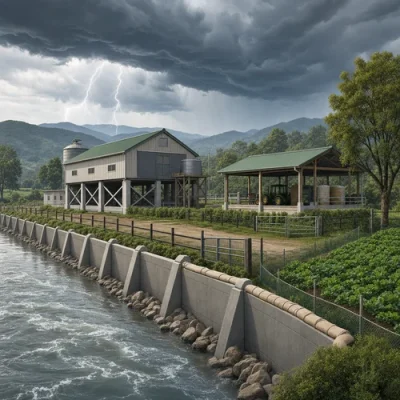
Natural disasters can affect farms in different ways depending on location, season, land use and infrastructure. A property in a flood-prone area may need different preparation from a farm exposed to cyclones, bushfire risk or prolonged dry conditions. While no plan can remove every risk, structured preparation can help reduce avoidable damage and support a faster, more organised response.
This guide outlines five key measures for Australian farmers preparing for natural disasters: assessing local risks, developing an emergency plan, strengthening infrastructure, protecting livestock and crops, and reviewing farm insurance arrangements.
1. Conduct a practical farm risk assessment
A risk assessment helps identify which natural disasters are most relevant to your region and how they could affect your farm. Different parts of Australia face different hazards. Some areas of Queensland and New South Wales are particularly exposed to flooding and cyclones, while many areas in Western Australia and South Australia may face severe drought conditions.
Identify likely hazards in your area
Start by gathering information from local government resources, agricultural bodies and community records. Look at which natural events have historically affected the region and how often they have disrupted farms, roads, water supplies or local services.
Common hazards to consider include:
- bushfires and grassfires
- flooding and flash flooding
- cyclones and severe wind events
- drought and water scarcity
- heavy rainfall, erosion and loss of topsoil
- heatwaves or extreme weather affecting livestock and crops
Assess vulnerable buildings, equipment and systems
Once you understand the likely hazards, review how your farm's infrastructure might perform under those conditions. Buildings, fences, water systems, irrigation, storage areas, machinery sheds and access tracks can all become vulnerable during a disaster.
Useful questions include:
- Are older buildings able to withstand high winds or heavy rain?
- Are roofs, walls and foundations in good condition?
- Are generators, pumps, irrigation systems and other machinery maintained?
- Are fuel, chemicals, feed and equipment stored securely?
- Are fences and gates suitable for emergency movement of livestock?
- Are low-lying areas exposed to floodwater or erosion?
A written inventory of structures, equipment, livestock, crops and key supplies can help you prioritise improvements. For equipment-specific risks, it may also be useful to review information about farm equipment insurance and claims as part of broader disaster planning.
Consider the likely impact on livestock and crops
Livestock and crops often require separate planning. Drought can affect water availability and feed supply, while floods can displace animals, damage pasture and remove valuable topsoil. Severe storms can damage shelters, fencing and crop storage.
Review current systems for irrigation, feed, shelter, fencing and animal movement. Depending on the farm, practical options may include drought-resistant crop varieties, flood barriers, improved drainage, reinforced shelters or designated holding areas for animals during extreme weather.
2. Develop a comprehensive farm emergency plan
A farm emergency plan sets out what should happen before, during and after a natural disaster. It should be practical, accessible and understood by everyone who works on the property.
Create disaster-specific response steps
Each major hazard needs its own response. A flood plan may focus on moving livestock to higher ground and protecting pumps or machinery. A bushfire plan may focus on access routes, firebreaks, water points and safe zones. A cyclone plan may focus on securing sheds, loose materials and essential equipment.
For each relevant disaster, document:
- early warning signs or alert sources to monitor
- actions to take before the event arrives
- actions to take during the emergency
- who is responsible for each task
- how livestock, crops, machinery and records will be protected
- what needs to be checked once conditions are safe
Regular drills and staff briefings can help make the plan easier to follow under pressure.
Establish communication procedures
Reliable communication is critical during a disaster. Establish clear communication channels for farm workers, family members, contractors and emergency services. Depending on the property and coverage, this may include mobile phones, radios or other devices.
The plan should nominate people responsible for key decisions, contacting staff, maintaining contact lists and communicating with emergency services. Contact details should be reviewed and updated regularly.
Plan evacuation routes and safe zones
Evacuation routes and safe zones should be mapped before an emergency occurs. Mark the safest and quickest routes to designated safe locations, including routes suitable for vehicles, trailers or livestock where relevant.
Safe zones may include areas outside the farm, higher ground, or secure buildings capable of withstanding the identified threat. Staff should know where these areas are and how to reach them. If livestock may need to be moved, the plan should also include trailers, holding areas and personnel responsible for animal safety.
3. Strengthen farm infrastructure and maintenance
Strong, well-maintained infrastructure can reduce the likelihood of avoidable damage during severe weather. The most useful improvements will depend on the property's risks, budget and existing condition.
Reinforce buildings for severe weather
Farm buildings should be assessed for weaknesses in roofs, walls, doors, foundations and openings. Reinforcement may include stronger roofing materials, bracing, storm shutters or repairs to ageing structures.
For significant upgrades, it may be appropriate to seek expert advice, such as from a structural engineer, particularly where buildings are exposed to high winds, heavy rain or repeated storm activity.
Maintain equipment before it is needed
Equipment can be critical during both response and recovery. Tractors, generators, pumps, irrigation systems, trailers and vehicles should be inspected and serviced on a regular schedule.
Staff should know how to complete basic checks and recognise warning signs of damage or wear. Reliable equipment can support evacuation, water management, livestock movement and post-disaster clean-up.
Use flood defences and erosion control where appropriate
Floodwater and heavy rainfall can damage buildings, crops, soil and access routes. Depending on the farm, flood defences may include levees, dykes or barriers to protect critical areas.
Erosion control may involve planting cover crops, building terraces, improving drainage or establishing windbreaks. These measures can help maintain soil integrity and reduce the impact of heavy rain and runoff. Farmers interested in soil protection may also find this guide to cover crops and sustainable farm yields useful.
4. Protect livestock and crops during emergencies
Livestock and crop protection should be built into the risk assessment and emergency plan. The right approach depends on the type of operation, the hazard and how much warning is available.
Safeguard livestock
Livestock planning should identify where animals can be sheltered or moved during extreme weather. Strong barns or reinforced shelters may help protect animals from heavy rain and wind, while higher ground may be important during floods.
A livestock emergency plan may include:
- designated safe paddocks, shelters or holding areas
- trailers or transport options for evacuation
- staff responsible for moving or monitoring animals
- feed and water arrangements during disruption
- routes that remain usable in wet, smoky or damaged conditions
Practising livestock movement before an emergency can make the process safer and more efficient if urgent action is needed.
Prepare crops for flood and drought risk
Crop protection often combines land management, water management and seasonal planning. For flood risk, raised beds, swales and improved drainage can help manage excess water. Flood-tolerant crop varieties may also be considered where appropriate.
For drought risk, efficient irrigation systems such as drip irrigation can help direct water where it is needed. Mulching and soil conditioning may also help retain moisture and support soil health during dry periods.
Use monitoring technology where it fits the operation
Technology can support faster decision-making by providing real-time or timely information about weather, soil and livestock conditions. Weather monitoring systems, soil moisture sensors and smart monitoring tools can help farmers adjust irrigation, monitor crop health or move livestock before conditions worsen.
These tools do not remove the need for planning, but they can provide useful information when conditions change quickly.
5. Review farm insurance as part of disaster planning
Insurance is one part of a broader disaster preparation strategy. It does not prevent physical damage, but it may help reduce the financial impact of insured events, depending on the policy terms, exclusions, limits and deductibles.
Understand the types of cover that may be relevant
Farm insurance arrangements can involve different types of cover. Depending on the farm and policy, this may include:
| Cover type | What it may relate to |
|---|---|
| Property insurance | Buildings, structures and equipment damaged by insured events |
| Crop insurance | Agricultural produce affected by events such as droughts or floods, subject to policy terms |
| Livestock insurance | Losses related to illness, accidents or disasters affecting animals, subject to the policy |
| Business interruption insurance | Income disruption during a recovery period where the policy responds |
The relevance of each cover type depends on the operation, assets, exposures and policy wording.
Read natural disaster terms carefully
Before choosing or renewing a policy, review how the policy treats natural disasters. Pay attention to covered events, exclusions, definitions, coverage limits and deductibles. Similar-sounding policies may respond differently depending on wording.
When considering cover levels, a farm insurance calculator may help organise estimates of the assets and operations that need to be considered. It should be used as a guide only, not as a guarantee of suitable cover or claim outcomes.
Compare policies and keep records current
Comparing providers and policies can help identify differences in coverage, limits and exclusions. If you are reviewing available options, you can compare farm insurance options as part of a broader review process.
Good records can also support claims and recovery planning. Keep updated inventories, photographs of buildings and equipment, livestock and crop records, maintenance schedules, receipts and copies of insurance documents in a safe and accessible location.
Use community and government resources
Farm disaster preparedness is often strengthened by local knowledge and support networks. Other farmers in the region may have practical experience with local flood paths, fire behaviour, evacuation routes, water access issues or recovery challenges.
Work with local farmer networks
Local farmer associations, agricultural meetings and informal networks can help farmers share information, equipment, labour and lessons learned. These networks may be particularly useful before and after major events, when practical support and local knowledge are important.
Stay informed about government assistance
Federal and state government assistance programs may be available following natural disasters. These can include grants, low-interest loans or subsidies to support recovery. Availability, eligibility and application processes can vary, so it is important to check official government sources and local agricultural departments for current information.
Use training and preparedness resources
Workshops, seminars and online courses can help farmers strengthen emergency planning, risk assessment and infrastructure preparedness. Training from agricultural institutions, government agencies and non-profit organisations may also support safer decision-making during disasters.
Disaster preparedness checklist for farms
- Identify the natural disasters most likely to affect your region.
- Inspect buildings, fences, machinery, water systems and storage facilities.
- Document emergency procedures for bushfire, flood, cyclone, drought and other relevant hazards.
- Assign responsibilities to workers and family members.
- Prepare communication procedures and keep contact lists updated.
- Map evacuation routes and safe zones for people and livestock.
- Maintain equipment needed for response and recovery.
- Plan livestock shelter, movement, feed and water arrangements.
- Use drainage, irrigation, soil health and crop selection strategies to manage flood and drought risk.
- Review farm insurance policies, limits, exclusions and records.
- Stay connected with local farmer networks and government information sources.
Conclusion
Preparing a farm for natural disasters involves practical planning across the whole operation. A risk assessment helps identify likely threats and vulnerable assets. An emergency plan helps workers respond consistently. Strong infrastructure, maintained equipment, livestock strategies and crop protection measures can reduce disruption where risks can be managed.
Insurance and records form another layer of preparation by helping farmers understand how financial losses may be treated under policy terms. Combined with local networks and government resources, these measures can support a more resilient farm operation when natural disasters occur.